AI—have you heard of it? Maybe the question should be, “Have you heard too much of it?” Clearly, AI has been and will continue to be one of the most disruptive technologies in modern times, although it has actually been around for over 70 years. But our view of it changed dramatically on November 30th, 2022, when Generative AI came into its own with the release of ChatGPT. It was a dramatic pivot and leap forward. Although chatbots have been around for a long time, most were limited, confusing, and sometimes (often?) provided incorrect information. Generative AI changed the game forever. Its ability to infer, learn, generate content, and guide us is astounding. All this has had immediate implications for the Learning & Development industry, and Workflow Learning is a powerful next step for this technology. We need to look across our practices and deliverables to see how we can help lead, influence, and create impact with this new set of tools, both in service to our work as well as the work of our learners.
With that in mind, we sought out some of the best L&D Leaders, and their teams, to see how they’re already leveraging AI for Workflow Learning, and what plans they have for the future. What follows is a collection of use cases that they provided. Because Generative AI is where most L&D teams are playing right now, the use cases reflect that. Of course, there is a broader world of AI, and while most L&D teams are focused on “training”, there is even greater opportunity for AI in the Performance Support arena (in the moments of Apply, Solve, and Change). But that’s fodder for another article.
Knowing that some of the following use cases are theoretical and/or in various planning stages while others are already being tested, we invite you to consider how these could apply in your organization—and to tell us what’s missing from this list!
From a Global Professional Services Firm:
Using GPTs to Boost Performance Support
The integration of Generative Pre-trained Transformers (GPTs) into the design and delivery of performance support systems offers transformative potential. By leveraging the advanced capabilities of OpenAI’s customizable GPTs, organizations can significantly streamline the process of Rapid Workflow Analysis (RWAs), enabling performance consultants to quickly generate strawman processes as well as identify inefficiencies and areas for improvement within existing workflows. This would allow organizations to save time in the design process by shifting from whiteboarding processes into validating and providing additional guidance to a first draft. Additionally, GPTs can be directly employed to provide real-time, context-sensitive support to employees, delivering tailored guidance and solutions at the point of need. This dual-use case scenario not only accelerates the diagnostic phase of performance consulting but also enhances the actual delivery of performance support, making it more accurate, relevant, and timely. By harnessing the power of GPTs, companies can achieve a higher level of operational excellence, fostering an environment of continuous improvement and innovation.
Use Case 1: Using GPTs to support Rapid Workflow Analysis
Stakeholders often have a harder time starting the brainstorming process when confronted with a blank page or are challenged by the time a RWA can take. A prototype GPT can be created that overcomes this challenge by generating a list of generic steps, given a brief interaction with the GPT. For example, see how the GPT provides a list of 24 steps to consider in planning a golf tournament for a local charity: https://chat.openai.com/share/d25537b2-6e7c-4c42-899e-f0eee0235cb6. With just 10-15 minutes of thought, you can have a substantive list of tasks to bring to a first stakeholder discussion.
Sometimes, you could get a solid list of steps, but you would like a thought partner to analyze the steps, find patterns, and suggest gaps. In cases where an initial RWA was performed and you have a broad list of steps and activities, you can use a GPT to group them into relevant tasks and processes. See how the GPT provides feedback to a preliminary list of social media posting steps here: https://chat.openai.com/share/a2b0d9f9-2a27-4d55-88a6-4bdde40726d7. The GPT isn’t a replacement for a skilled performance consultant, but rather, it provides a potential performance boost by offering suggestions and ideas as the designer tests and shapes her or his Rapid Workflow Analysis.
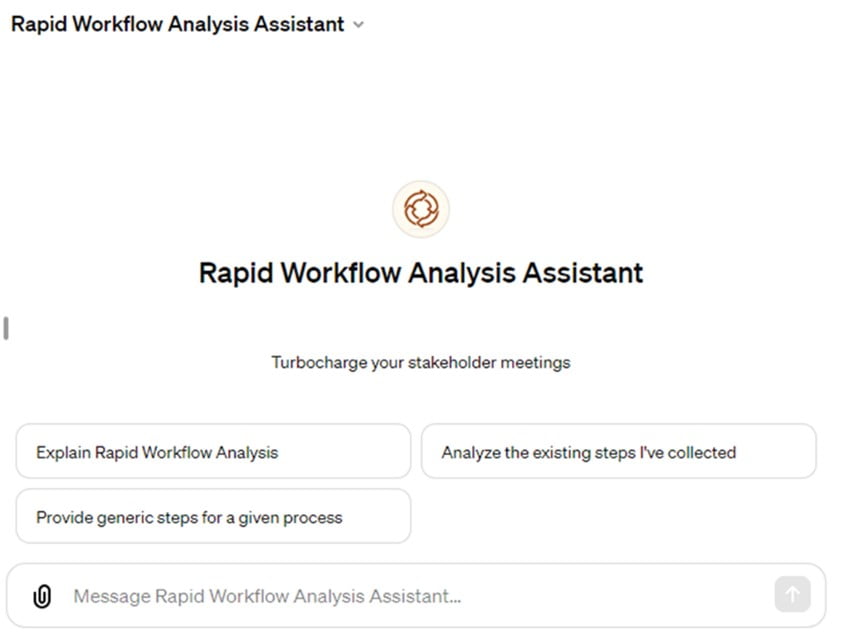
If you have a ChatGPT Plus (4.0) account, you can try this GPT Demo here: https://chat.openai.com/g/g-l5TsY8V7n-rapid-workflow-analysis-assistant
Use Case 2: Using a GPT as a way to interact with a performance support platform
A well-designed GPT can be used as performance support aligned to users’ moments of need. This changes the interaction from a portal where you need to find what you are looking for to an interactive interface where you can ask direct questions on the specific task/step you need support with. We built a prototype GPT for Event Managers at a fictitious simplified conference planning agency. To test the GPT, we created:
- A marketing manual
- A conference planning system (EVENTZ) guide
- A checklist of steps required
- A budget template
All of these documents are part of the GPT configuration and are used to populate responses. See how the tool is useful for onboarding (NEW): https://chat.openai.com/share/e3d039e8-9c8c-4512-823d-8909ceca45de, and later when the user is looking to accomplish a specific task (APPLY): https://chat.openai.com/share/fe91c305-ffe0-4b80-8321-2fd829c86366. As you can see, this GPT prototype presents immediate, contextual support to Event Managers, streamlining their workflow and enhancing their decision-making processes.
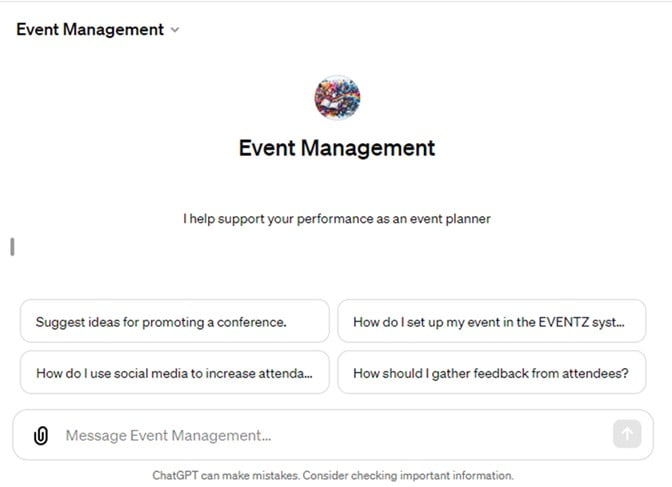
If you have a ChatGPT Plus (4.0) account, you can try the GPT here: https://chat.openai.com/g/g-45QoRShw6-event-management
From a Large Insurance Company:
- Customized Change Management (or other) Communications
- AI writes personalized communications based on users’ roles, performance, and career interests.
- Awareness & Desire (delivering messages that appeal to what a person values most)
- Reinforcement (providing tailored messaging based on how a team/person is performing; could be constructive or even positive)
- Reinforcement of Correct Processes
- AI identifies that a process someone is doing has recently changed and ensures they have the latest steps in front of them.
- Impacted Material Identification
- AI scans all learning materials and performance support sites to identify if and where content is impacted by a process change.
- Performance Reviews
- AI scans Workday, evaluates the materials produced by a person, their skill matrix progression, etc. and writes a performance review.
- AI writes personalized communications based on users’ roles, performance, and career interests.
- A user interacts with a digital twin AI (video representation of a person) to ask ‘an expert’ content questions or practice skills like empathy, negotiation, listening, conflict, etc.
- Chase Bank is doing something like this.
- AI personalizes content delivered to a user based on things like role, skill level, previous performance, or other dynamics.
- Allow the user to select dynamics of their choice for customization.
- Of particular interest is something that could understand and deliver content based on performance. For example, if task A normally takes 1 minute and Jill is 90% done with it at 40 seconds, she receives nothing. But if Joe is only 10% into it at 40 seconds, AI realizes he’s in trouble and offers content for help.
From a Large Manufacturing Company:
- One of the biggest opportunities with generative AI is the use of safe experimentation—finding opportunities for practice and learning (in the moment of Apply). With that in mind, we piloted a generative AI tool that has been trained on leadership and change concepts. It provides opportunities for users to test out process steps for implementing large-scale projects (e.g., stakeholder engagement, communications, influence management, etc.) while building out scenarios and seeking responses for various situations. The value of this effort is scaling of otherwise constrained change management resources.
- Another AI use case we are exploring for L&D is in the realm of quality checks against requirements. One of the advantages of a generative AI tool is the summarization of multiple documents collected during analysis. A key element of course objectives and sessions is the validation of learning outcomes with stakeholder requirements. This is a quality step that is often missed as we build the learning curriculum. We are finding that validating curriculum against needs analysis before the roll-out makes the process significantly less cumbersome and more rewarding for the designer.
From a Learning Tech Provider:
- We want to supplement the search in our performance support tool with a GPT chatbot that already provides a solution or a summary of the requested task and the user only accesses the source if necessary.
- We want to offer LLM support for all WBT content that we are still developing traditionally. If a company has a corporate GPT in use, this can then also provide information on the WBT content. Instead of “Chat with my PDF”, this would then be “Chat with my WBT”.
From a Branch of the US Military:
- Our organization is using AI to write first-draft competency statements for various positions, and then we meet with SMEs to validate/correct the output from AI. This could also be used to generate processes and tasks for creating Digital Coaches during the RWA. However, I am leery of feeding documentation into a system with unknown future ramifications. If I feed 20 documents into an AI system, and it generates processes and tasks based on that, now the system has access to the information in the 20 documents that I uploaded.
- I recently stumbled upon something called Blackbox AI that takes YouTube videos and summarizes them. For training purposes, I could see this as potentially valuable, but we haven’t leveraged it yet: https://www.youtube.com/watch?v=n-bairXObPY
From a Large Tech Company:
A large tech company is experimenting with AI that workers interact with as it provides performance support in the workflow. These workers are charged with developing reusable, structured content, architected to support all five moments of learning need (New, More, Apply, Solve, Change) in a system that allows metadata tagging and extraction. They hypothesize that this content is optimized to support the process of training AI. Additionally, the content architecture they use provides an excellent mechanism for training generative AI to transfer knowledge from a SME directly into those structures.
To Wrap Up…
It’s a brave new world. As we said, the use cases shared above are but a fraction of AI’s potential, but we have to start somewhere and begin to host these conversations. We need to share best practices, try new things, and fail our way to success to finally lift our industry and those we serve to a whole new level of business impact. AI will have far reaching outcomes beyond L&D’s small corner of the world. It will produce transformational change in the world of work and life in general. We in L&D need to be a part of that change. We need to remember our charge: to enable performance at every changing moment to help drive business impact and value. We have an obligation to take on this new challenge, lead the discussion where appropriate, and adopt approaches like the ones outlined above. Hopefully, this article helps move things forward. We’re anxious to hear your feedback and experiences!